Posts

Showing posts with the label ACLS

“You’re Not a Trauma or Pediatric Hospital? That’s Exactly Why You Should Be Prepared.”

Image
You're Not a Trauma or Pediatric Hospital? That’s Exactly Why You Should Be Prepared. Let’s talk about something that’s been making me absolutely nuts —and if you’re a fellow ED nurse, I know you’ll feel this in your bones. I’ve had far too many conversations with Emergency Department Directors, Nurse Managers, and even CNOs who push back when I ask why their staff aren’t required to have TNCC or ENPC certification. The answers? “We’re not a trauma center.” “We’re not a pediatric hospital.” “It’s the cost…” Let me be crystal clear: that is exactly why your staff need this training. You’re not a trauma center. You’re not a pediatric hospital. So what happens when a multi-system trauma patient rolls into your adult-only ED? Or when a critically ill child is brought to your doors because the parents panicked and went to the nearest hospital—not the “right” one? Are you really going to tell the parents of a seizing 2-year-old, “So...

Heart Code Courses: The Future of Skill Development, Time Management, and Cost-Efficient Healthcare Training

Image
In today's healthcare landscape, professionals are continuously seeking ways to enhance their life-saving skills , manage their time effectively, and stay within budget. Heart Code courses —whether you're certifying in BLS , ACLS , or PALS —are emerging as the top solution for professionals looking to stay current. These courses offer a flexible, effective, and cost-efficient approach to healthcare certifications, making them the ideal choice for today’s fast-paced medical environment. 1. Effective Skill Development with Heart Code Healthcare professionals need consistent, up-to-date training to maintain life-saving skills . Heart Code courses use interactive, online learning paired with hands-on skills testing to ensure professionals retain the most critical information. The engaging, scenario-based format means that learners can practice repeatedly until they achieve confidence in emergency situations. This method of learning is particularly beneficial for those loo...

Legal Issues with Code Blue

Image
Did You Document? This is one of the biggest issues we face in nursing.  I truly feel nurses are awesome at what we do when it comes to actual hands-on.  However, when it comes to documentation; We Suck !   Every nurse I know and have worked with; I would say that less than half; has ever wondered about the legal ramifications of an in-hospital cardiac arrest (code blue). Code blue events happen fast, and documenting the entire event correctly may be a difficult and daunting task. Unfortunately,  in today's nursing environment; especially with the arrival of the EHR(electronic health record) nurses are becoming more vulnerable to legal actions. If you don't document it wasn't done.    Yeah Yeah!!  I know you have heard that a million times; but do you really listen? N urses are being named defendants in malpractice lawsuits, according to the Nurses Service Organization (NSO).  " Of the 549 nurse...

2015 American Heart Association (AHA) Advanced Cardiac Life Support (ACLS) Changes

Image
2015 ACLS Summary of Key Issues and Major Changes Vasopressors for Resuscitation : Vasopressin 2015 ( Updated ) : Vasopressin in combination with epinephrine offers no advantage as a substitute for standard-dose epinephrine in cardiac arrest. 2010 ( Old ): One dose of vasopressin 40 units IV/ intraosseously may replace either the first or second dose of epinephrine in the treatment of cardiac arrest. Why: Both epinephrine and vasopressin administration during cardiac arrest have been shown to improve ROSC. Review of the available evidence shows that efficacy of the 2 drugs is similar and that there is no demonstrable benefit from administering both epinephrine and vasopressin as compared with epinephrine alone. In the interest of simplicity, vasopressin has been removed from the Adult Cardiac Arrest Algorithm. ETCO2 for Prediction of Failed Resuscitation 2015 ( New ): In intubated patients, failure to achieve an ETCO2 of greater than 10 mm Hg by waveform capnog...

I Hate those Videos from the American Heart

Image
We have been teaching CPR , ACLS , and PALS for over 5 years now and I always get the same complaint from many students.  "Why do we have to watch those stupid videos?"  We know that some of the videos you watch can be boring or repetitive; however, there is a madness behind the methods from the American Heart Association. A recent student from the Perelman School of Medicine at the University of Pennsylvania finds "using a video to train members of patients at risk for cardiac arrest in CPR may be just as effective as using the traditional hands-on method with a manikin." "The findings suggest simplified and more cost-effective approaches may be useful for disseminating CPR education to families of at-risk patients and the general public. The results are being presented during the American Heart Association Scientific Sessions 2015." (Abella, MD, MPhil) The cardiac arrests in the United States are typically responded and treat...

New recommendations for treating patients with high blood pressure and cardiovascular disease

Image
" American Heart Association   Scientific Statement" March 31, 2015  Categories:  Heart News ,  Scientific Statements/Guidelines Statement Highlights Three professional organizations have issued a joint statement on treating high blood pressure in people who have been diagnosed with coronary heart disease, stroke or other forms of heart disease. The statement reinforces the goal of reducing blood pressure to under 140/90 in order to reduce the risk of heart attack and stroke. Patients should know their blood pressure, make lifestyle changes to reduce their risk of heart attack and stroke, and work with a physician to safely lower their blood pressure. This article was published in DALLAS, Texas on  March 31, 2015 .  The American Heart Association came out and discussed a new scientific statement issued jointly by three medical organizations and published in the American Heart Association’s journal  Hypertension ,...

Stroke Falls to No. 5 Cause of Death in U.S.

Image
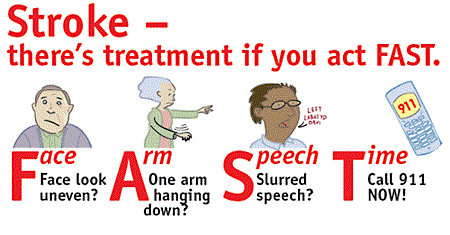
Back in December 2014; the AHA posted an article promoting the fact that " Stroke   has dropped from the nation’s fourth-leading cause of death to No. 5", according to new statistics. This drop is the second time since 2011 that stroke has dropped in the national mortality rankings. According to the  Centers for Disease Control and Prevention report released ,  stroke has switched positions with unintentional injuries, which killed 1,579 more people than stroke in 2013, according to the very latest data available.  In 2013, the leading causes of death were: heart disease, cancer, chronic lower respiratory diseases, unintentional injuries, stroke, Alzheimer’s disease, diabetes, influenza and pneumonia, kidney disease, and suicide. The stroke death rate dropped slightly, from 36.9 percent in 2012 to 36.2 percent in 2013. While the death rate from heart disease dropped somewhat between 2012 and 2013, it remains the No. 1 cause of death in the nation. Cancer is ...