Posts

Showing posts with the label BLS

Heart Code Courses: The Future of Skill Development, Time Management, and Cost-Efficient Healthcare Training

Image
In today's healthcare landscape, professionals are continuously seeking ways to enhance their life-saving skills , manage their time effectively, and stay within budget. Heart Code courses —whether you're certifying in BLS , ACLS , or PALS —are emerging as the top solution for professionals looking to stay current. These courses offer a flexible, effective, and cost-efficient approach to healthcare certifications, making them the ideal choice for today’s fast-paced medical environment. 1. Effective Skill Development with Heart Code Healthcare professionals need consistent, up-to-date training to maintain life-saving skills . Heart Code courses use interactive, online learning paired with hands-on skills testing to ensure professionals retain the most critical information. The engaging, scenario-based format means that learners can practice repeatedly until they achieve confidence in emergency situations. This method of learning is particularly beneficial for those loo...

Practical and Easy-to-Use Technology for Seniors

Image
Written by Guest Blogger: Andrea Needham Populations are  aging  all around the world, requiring innovative approaches to keep up with their care. The great news is that advances in technology make keeping up with the demand for senior-friendly tools easier than ever. You can improve your daily quality of life by simply investing in some easy-to-use and practical devices. Get inspired by the below overview of products. Invest in streaming TV and movies Older individuals tend to spend a fair amount of time at home due to decreased mobility. Skip the traditional cable television and opt for a streaming device instead so you can view your favorite movies and shows at any time. Streaming sticks offer access to  more than 500,000 options . It's also easy to set up and there's no need to deal with the cable company—meaning lower costs as well. Another way to simplify entertainment is to get a tablet. This allows you to view programs from the comfort of you...

2015 American Heart Association (AHA) Advanced Cardiac Life Support (ACLS) Changes

Image
2015 ACLS Summary of Key Issues and Major Changes Vasopressors for Resuscitation : Vasopressin 2015 ( Updated ) : Vasopressin in combination with epinephrine offers no advantage as a substitute for standard-dose epinephrine in cardiac arrest. 2010 ( Old ): One dose of vasopressin 40 units IV/ intraosseously may replace either the first or second dose of epinephrine in the treatment of cardiac arrest. Why: Both epinephrine and vasopressin administration during cardiac arrest have been shown to improve ROSC. Review of the available evidence shows that efficacy of the 2 drugs is similar and that there is no demonstrable benefit from administering both epinephrine and vasopressin as compared with epinephrine alone. In the interest of simplicity, vasopressin has been removed from the Adult Cardiac Arrest Algorithm. ETCO2 for Prediction of Failed Resuscitation 2015 ( New ): In intubated patients, failure to achieve an ETCO2 of greater than 10 mm Hg by waveform capnog...

Stroke Falls to No. 5 Cause of Death in U.S.

Image
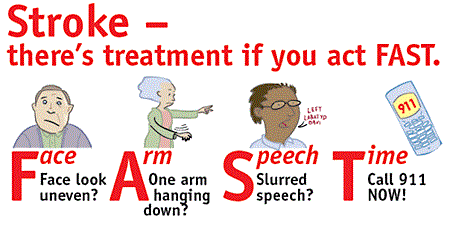
Back in December 2014; the AHA posted an article promoting the fact that " Stroke   has dropped from the nation’s fourth-leading cause of death to No. 5", according to new statistics. This drop is the second time since 2011 that stroke has dropped in the national mortality rankings. According to the  Centers for Disease Control and Prevention report released ,  stroke has switched positions with unintentional injuries, which killed 1,579 more people than stroke in 2013, according to the very latest data available.  In 2013, the leading causes of death were: heart disease, cancer, chronic lower respiratory diseases, unintentional injuries, stroke, Alzheimer’s disease, diabetes, influenza and pneumonia, kidney disease, and suicide. The stroke death rate dropped slightly, from 36.9 percent in 2012 to 36.2 percent in 2013. While the death rate from heart disease dropped somewhat between 2012 and 2013, it remains the No. 1 cause of death in the nation. Cancer is ...