Posts

Showing posts with the label PALS

“You’re Not a Trauma or Pediatric Hospital? That’s Exactly Why You Should Be Prepared.”

Image
You're Not a Trauma or Pediatric Hospital? That’s Exactly Why You Should Be Prepared. Let’s talk about something that’s been making me absolutely nuts —and if you’re a fellow ED nurse, I know you’ll feel this in your bones. I’ve had far too many conversations with Emergency Department Directors, Nurse Managers, and even CNOs who push back when I ask why their staff aren’t required to have TNCC or ENPC certification. The answers? “We’re not a trauma center.” “We’re not a pediatric hospital.” “It’s the cost…” Let me be crystal clear: that is exactly why your staff need this training. You’re not a trauma center. You’re not a pediatric hospital. So what happens when a multi-system trauma patient rolls into your adult-only ED? Or when a critically ill child is brought to your doors because the parents panicked and went to the nearest hospital—not the “right” one? Are you really going to tell the parents of a seizing 2-year-old, “So...

American Heart Association's E-Cards

Image
IT's COMING!! January 2018 The AHA's eCards will be mandatory starting January 2018. If you are not ready; then get ready.   Visit http://heart.org/cpr/mycards -- Electronic course completion cards Beginning January 1, 2018, all US-based AHA Training Centers will be required to use AHA's ecards for the issuance of course completion cards to providers and students who successfully complete the requirements of AHA courses. eCards reduce the risk of counterfeits, improve the efficiency of card management, ensure the identity of the issuing TC and Instructor, and allow students to store proof of their course completion electronically. This will be a significant change for students & providers The American Heart Association eCards offer a simple, secure, and efficient way to provide students with their credentials after they complete a course. eCard features and benefits : Electronic course completion cards are viewable online, and offer a...

2015 American Heart Association (AHA) Advanced Cardiac Life Support (ACLS) Changes

Image
2015 ACLS Summary of Key Issues and Major Changes Vasopressors for Resuscitation : Vasopressin 2015 ( Updated ) : Vasopressin in combination with epinephrine offers no advantage as a substitute for standard-dose epinephrine in cardiac arrest. 2010 ( Old ): One dose of vasopressin 40 units IV/ intraosseously may replace either the first or second dose of epinephrine in the treatment of cardiac arrest. Why: Both epinephrine and vasopressin administration during cardiac arrest have been shown to improve ROSC. Review of the available evidence shows that efficacy of the 2 drugs is similar and that there is no demonstrable benefit from administering both epinephrine and vasopressin as compared with epinephrine alone. In the interest of simplicity, vasopressin has been removed from the Adult Cardiac Arrest Algorithm. ETCO2 for Prediction of Failed Resuscitation 2015 ( New ): In intubated patients, failure to achieve an ETCO2 of greater than 10 mm Hg by waveform capnog...

Stroke Falls to No. 5 Cause of Death in U.S.

Image
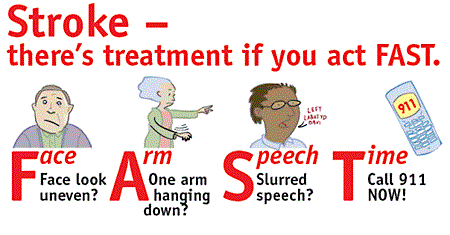
Back in December 2014; the AHA posted an article promoting the fact that " Stroke   has dropped from the nation’s fourth-leading cause of death to No. 5", according to new statistics. This drop is the second time since 2011 that stroke has dropped in the national mortality rankings. According to the  Centers for Disease Control and Prevention report released ,  stroke has switched positions with unintentional injuries, which killed 1,579 more people than stroke in 2013, according to the very latest data available.  In 2013, the leading causes of death were: heart disease, cancer, chronic lower respiratory diseases, unintentional injuries, stroke, Alzheimer’s disease, diabetes, influenza and pneumonia, kidney disease, and suicide. The stroke death rate dropped slightly, from 36.9 percent in 2012 to 36.2 percent in 2013. While the death rate from heart disease dropped somewhat between 2012 and 2013, it remains the No. 1 cause of death in the nation. Cancer is ...